Google
 

Tuesday, November 30, 2010

When Downtown Crossing had Christmas Magic

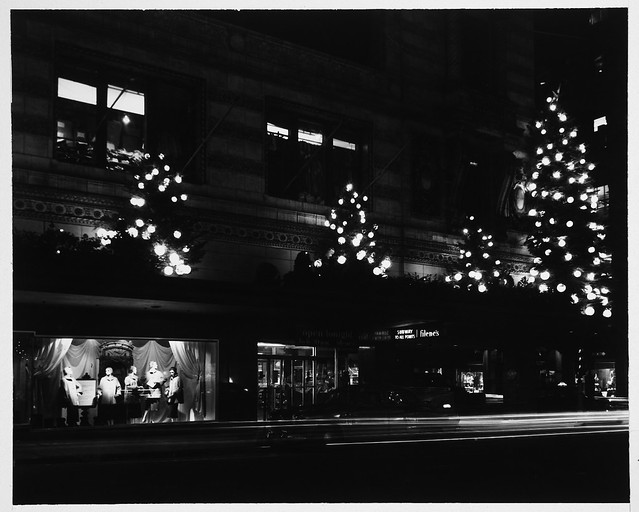
When I was a child growing up in the late 1950's, the area now known as Downtown Crossing was magical starting the day after Thanksgiving and people came from all over New England to see the sights.

                Jordan Marsh had this huge Nativity scene on their facade on Summer Street.

        Windows at Jordan's along Washington Street rivaled anything you could find in Manhattan


                   Washington St near Franklin was the home of Raymond's Department Store
                   Jordan's arch rival Filene's also went all out with windows that would dazzle

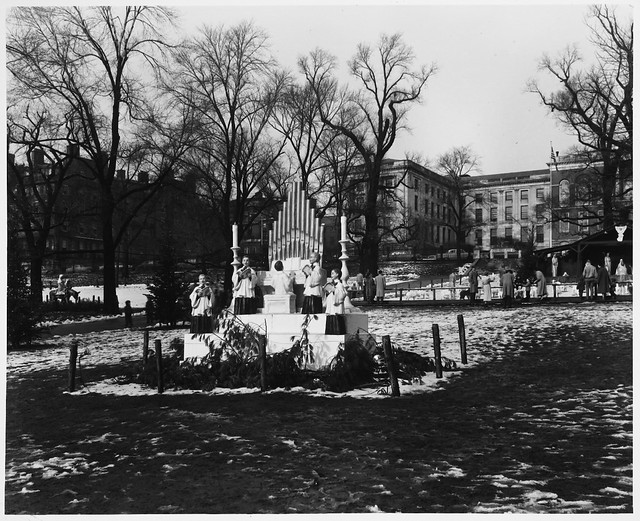
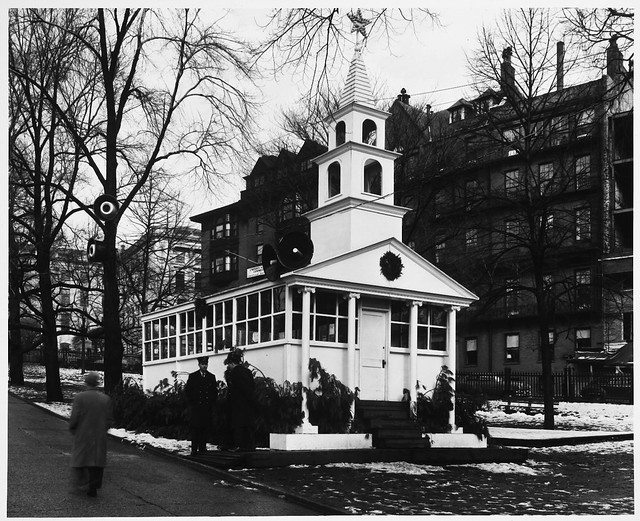
The Boston Common went all out as well - these decorations were holdovers from when James Michael Curley was the Mayor and he wanted to remind the State House that Boston was very Catholic.


This is a small part of the Boston that existed in the years after World War II.

I would like to thank the MIT Rotch Library for allowing me to share these photos with you.

Their entire collection of Boston circa 1955-64 is on Flickr. It captures Boston of that era.


Sunday, November 28, 2010

Questions that MUST be asked about James DiPaola


Like everyone else I am stunned by the events of the past week that resulted in the suicide of Middlesex County Sheriff James DiPaola.

It was only one week ago when the Boston Globe wrote about his pension scheme.

This part leaps out at me
DiPaola, a 57-year-old Democrat, had quietly filed retirement papers on Oct. 28, looking to exploit a section of the state pension law that allows retirees to run for paid elective office without losing their pensions. All he had to do was not accept a paycheck until his new term began in January.

That gambit, which even his own employees seemed unaware of, would have increased his annual income by $98,500 for doing the same job he’s been doing since 1997.

Now SOMEBODY at the State Board of Retirement ( run by soon to depart Tim Cahill) had to know what he was up to, yet they chose not to say anything BEFORE Election Day.

WHO????

Massachusetts Attorney General Martha Coakley must find this out. Applying for retirement is a matter of public record and yet nobody knew anything until the Globe broke the story last Sunday. Once re-elected he was home free.

But, DiPaola certainly knew this would become public knowledge after the election so I am having trouble believing that talking to a Globe reporter made him change his mind.

Honestly I think this may well be a major piece of the puzzle.

Howie Carr had DiPaola on his WRKO show last Monday and the Herald today printed a partial transcript of the interview. Certainly he didn't seem especially troubled by all of this.

He talks about new charges raised by FOX25
(Carr)

Do you want to say anything to Fox for their story (alleging improper use of campaign funds)?

(DiPaola)

They did their report, I sat with them for 45 minutes. We answered all their questions. Their allegations are false. I’m not going to let that distract from the day. We have been talking about these things for seven months. You know how these things work. Certainly I would have made a different decision, and I wouldn’t have been in this position right now. I would have not run for re-election. There’s no wrongdoing, and certainly as you know, people can write things with sources.

Here is the entire interview from the WRKO website.

I can't recall anything like this happening in Massachusetts. I do recall a politician in Pennsylvania killing himself on live statewide television back in 1987 which TV stations chose to show over and over.


My prayers go to DiPaola's wife, 3 daughters and grandchildren.

Wednesday, November 3, 2010

When Allston was home to a Major League Baseball team


On August 18th, 1915. the Boston Braves of the National League opened the doors to their new baseball palace a mile west of Kenmore Square at Commonwealth and Gaffney Street.

The website ballparks.com describes it


Braves Field was the last and largest of the first wave of concrete-and-steel ballparks built between 1909 and 1915. Owner James Gaffney built a wide open ballpark conducive to inside-the-park home runs. A covered single-deck grandstand seating 18,000 wrapped around the diamond from well down each foul line. Two uncovered pavilions seating 10,000 apiece occupied the areas just past the grandstand up to the foul poles. The jury box, as it was called after a sportswriter noticed during a game that only 12 spectators were sitting in the section, seated 2,000 and was located in right field.

With the advent of the lively ball, baseball became a game of over-the-fence home runs for which Braves Field was ill equipped. So, in 1928 the fences were moved in and subsequently tweaked for years thereafter. After the Braves left in 1953, Boston University purchased the property, converted it for football and changed its name to Nickerson Field, where the B.U. Terriers played football until 1997. Field hockey and soccer games as well as commencement ceremonies are still held there. The old right-field pavilion has been incorporated into Nickerson's seating arrangement. The left field pavilion was replaced by an arena and the grandstand was replaced by three high-rise dormitory buildings. The first base ticket office and the concrete outer wall in right and center field are still standing.


Below is a photo of the scoreboard in the left field section of old Braves Field. The scoreboard made its debut during the 1948 season, a season in which the Boston Braves won their last National League pennant before their relocation to Milwaukee in the spring of ’53 The scoreboard rose 68-feet from the ground and cost $70,000, a hefty price back then. It started the trend that has led to today’s modern era of monster boards with their huge HD displays. When the Braves left Boston, the scoreboard was dismantled and shipped to Kansas City where their ballpark was being made ready to welcome another ball club on the move, the Philadelphia Athletics.


By the early 50's the Braves could no longer compete with the Red Sox and Ted Williams even though the team had won a pennant in 1948. Sadly the intergration of the National League played a role as Boston in those days was not tolerant to people of color. The team would move to Milwaukee in 1953 and won a World Series against the Yankees in 1957.

The Braves were the team of choice for fans living in Allston, Brighton, Newton Corner, Newtonville, Watertown, Cambridge and Somerville due to easy streetcar access.

The right field bleachers still stand today on the BU West Campus and on Gaffney Street you can still see the old ticket and business office of the Braves.

Tuesday, November 2, 2010

I am seeing voter anger firsthand


I have spent a few hours today helping out at a polling place just outside of Harvard Sq. What I have seen so far is a heavy turnout of senior citizens and they are unified in their anger at Beacon Hill and Washington. Keep in mind many of these elders came of age with Jack Kennedy and Tip O'Neill in Cambridge. Yet today I have seen many clutching the Metro and NY POST and saying how they agree.


What is fueling their anger is the announcement a couple of weeks ago that the cost of living index has not gone up enough to merit an increase in their social security checks. They are very, very upset.

This polling place also has several Harvard undergraduate and graduate residences in it and as of 2:30 PM the students are NOT voting at all.

Tip O'Neill said famously "ALL POLITICS IS LOCAL" - and he would be listening to these people. I fear Obama and his advisors do not.

Tuesday, October 26, 2010

An Open Letter to T GM Richard Davey


I have been riding the T since it was known as the MTA of Charlie fame.


Lately I have not been driving as much and riding the T more and I have some observations of where the MBTA is today.


SUBWAY

When I first started riding what is now known as the Red Line it ran only from Harvard to Ashmont. Four car trains were seen in rush-hour but otherwise they often ran TWO car trains and the equipment dated back to 1912. Those cars were not replaced until 1963 with the so called blue birds.


The Orange Line was the elevated and they replaced the older cars around 1958 (some 1920's trains made it to the late 70's) but it also ran two-car trains in non peak times.


The Blue Line also had trains dating back to the 1920's and many trains ended at Orient Heights.


It is amazing to see what the system has become.

The Green Line was always the workhorse and until 1969 also had the WATERTOWN line ( today the 57 bus) But it was never as crowded as it is today at almost all hours.

I do believe one flaw in the way the Green Line has changed is that the lines have never been adjusted for changes in passenger load.

Today the B Line ends at Government Center and that only happened because the LRV's could no longer turn around at Park St. Still the B should be extended to Lechmere as between the North Shore bus terminal at Haymarket, Commuter Rail at North Station and the huge increase of passenger traffic to Lechmere that end of the Green Line is under-served.

The Lechmere of my youth was simply the end of the line for people to catch buses to Somerville, Arlington and Medford with the occasional person going to the old Lechmere Sales store on First St. However today you now have the Cambridgeside Galleria which beings in shopers from the Back Bay, South End, Dorchester and Roxbury as it is the only full blown mall close to downtown. A few years ago when North Station was being rebuilt the T DID have 2 of the Green Lines terminate at Lechmere and it worked well.

Simply put there is no good reason to end the B at Government Center except "Well that is how we have always done it."

SILVER LINE

I now use the Silver Line to go to Logan from Cambridge and the service is very good. If anything the line is becoming a victim of it's own success as when there is a convention in the Seaport area the Silver Line can not handle both the airport and convention goers. Somehow headway needs to be increased which I assume is one of the reasons SL3 was discontinued to add bused to SL1 and SL2.

The most recent figures I can find for MBTA ridership by line and station are from 2008-9.


The Silver Line figures appear to be from 2006 and are very low in the report. It seems like the line has become very popular with travelers leaving Logan.


Something to consider here : The Silver Line is now becoming a 'first impression' of people visiting Boston and it shows off how the Seaport area has exploded.

BUS SERVICE

I use the #1 Harvard-Dudley bus daily and it has its good days and bad days. If ever a line screamed for 60 foot buses it it this one ( and the #66 ) as most buses are packed from 7 AM to 9 PM. I have found the new bus tracking system useful.

Other than those two lines I have no real complaint with the bus service. I do understand Boston is not a traffic friendly city.

COMMUTER RAIL

I wish we could use the plastic Charlie Card on the train. How hard can it be to do this?

My only other complaint is minor but it would seem that somehow the #94 bus which services West Medford station could be adjusted someone so connections between the two lines would be better.

I do hope we will see arrival times of the subway trains on the electronic signs at each train station. A cell phone application at most stations is useless for lack of a signal. I am assuming that all that is needed for the signs to display the time is software?

Overall I think you have done a fine job since taking over the T.


HARVARD STATION 1976


PLEASE 60 FOOT BUSES on the 1 and 66???